
Last updated
How many restrooms does a race need?
Start with the crowd, not the miles. A field of 500 runners plus 200 spectators needs restrooms sized for 700 people standing around before a gun goes off, which is a different math than mid-course. Our guide on how many porta potties you need walks through the ratio in more detail, but for race day, cluster most units at start/finish and drop 1 to 2 standard portable toilets at aid stations past mile 3 if the course loops back near a road. OSHA 1926.51(c) sets construction-site ratios, not race ratios, but race directors in Hartford often use it as a rough floor: 1 toilet per 20 people for a small volunteer or staff crew working the event. For runners and spectators, plan tighter. A marathon course that finishes near Old Town will draw families and cheering sections that outnumber the runners themselves, so budget restrooms for the whole crowd, not the bib count. If your course crosses into Meriden, 5.4 miles north, or finishes closer to Middletown, 5.4 miles southeast, coordinate unit counts with whichever finish line draws the bigger crowd. Every cluster of standard units also needs an accessible option under ADA Standards section 213.2, which requires at least 5 percent of clustered units be accessible, never fewer than one.
Where should restrooms go on a race course?
Put them where runners slow down, not where it is easiest to park a truck. Start corrals, water stops, and the finish chute all create bottlenecks, and a restroom placed 50 feet off the course beats one placed for delivery convenience. Placement guidance applies to race day the same as it does to a job site: units need a stable, level surface under ADA Standards section 302.1, and the route to reach them needs a clear 36 inch path per ADA Standards section 403.5.1. If your race uses light towers or a temporary power pole for early-morning starts before sunrise, know how to brace a temporary power pole before crews set it: guy lines staked at an angle away from foot traffic, base plates on stable ground per ADA Standards section 302.1, and lines flagged well clear of the restroom queue and runner corral so nobody clips one jogging past in the dark. A temporary power pole also needs clearance from tents and barrier lines, so map it before you map your porta potties, not after. If your course needs crowd control barriers to separate the finish chute from spectators, restrooms should sit inside that fenced zone for staff and outside it for the public, with a marked path in between. Races that also stage a beer garden or festival area at the finish should look at festival restroom counts separately, since that crowd lingers far longer than a runner headed to their car.
What does race restroom rental cost in Hartford?
Pricing runs by event, not by the day, once you are staging more than a handful of units for a single morning.
| unit | duration | low | typical | high |
|---|---|---|---|---|
| standard | event | $200 | $400 | $800 |
| ada | day | $200 | $230 | $400 |
| deluxe | day | $85 | $300 | $1200 |
| trailer | event | $2499 | $3500 | $3899 |
A small neighborhood 5K in Hartford can run on standard units alone. A marathon with a finish-line festival, photo ops, and VIP runners often adds a restroom trailer for staff or sponsors, priced by the event rather than the day. Delivery adds a separate fee, and races with an early load-in or late strike often land in a higher band since crews need equipment on-site before dawn and cleared same night. For full detail on how these numbers get built, our cost breakdown page covers delivery and service fees line by line, and the per-day rental page is useful if your race is small enough to rent daily instead of by event package.
Races that stretch across town lines add logistics. A course finishing near Glastonbury, 3.5 miles south, or looping toward Bristol, 4.6 miles southwest, may need units delivered to two different points hours apart, which changes the delivery fee more than the unit count. Hartford Porta Pros builds race quotes around the course map, not a flat per-unit price, because a 26.2 mile route has different pinch points than a 5K loop.
How far in advance should I book race restrooms?
Book as soon as your course map and expected field size are locked, ideally weeks out for a marathon-sized event. Race weekends compete with weddings and festivals for the same trucks, and emergency rental options exist but cost more and can't guarantee placement timing for a fixed start gun.
Do I need an ADA unit for a small race?
Yes. ADA Standards section 213.2 requires at least one accessible unit anywhere standard units are clustered, regardless of field size. A 200-runner race still needs one ADA unit at the start/finish area. See ADA restroom requirements for full detail.
Can restrooms be placed mid-course, not just at start/finish?
Yes, and for anything over a 10K, they should be. Aid stations near mile markers are a natural spot, especially where the course loops back near a road for delivery access. Check the placement guide for surface and access requirements.
What if my race also needs fencing or barriers?
Many races combine restrooms with temporary fencing or crowd control barriers to manage the finish chute. Order them together so delivery trucks can coordinate one site visit instead of two separate ones.
Does a marathon need handwashing stations too?
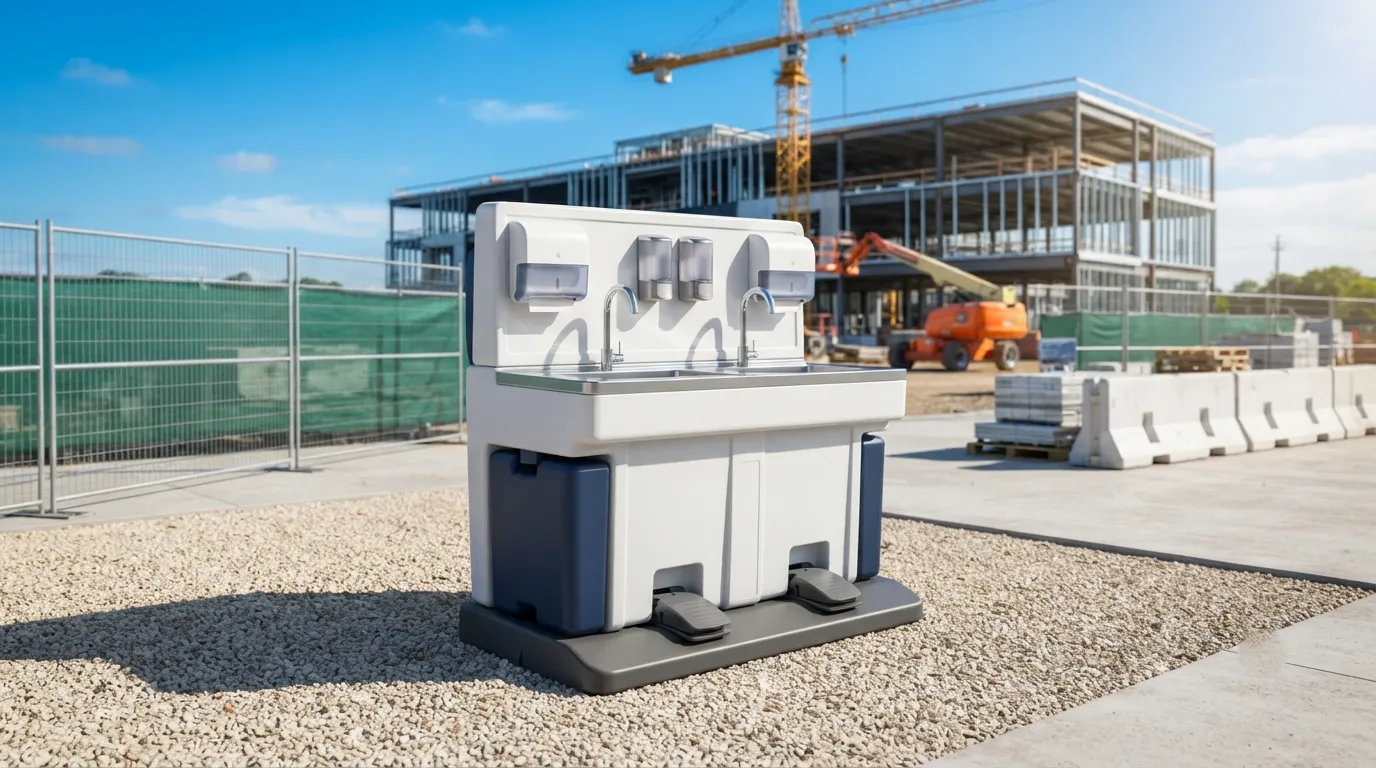
Yes, especially near any aid station serving food or drinks. Handwashing station rental pairs well with restroom clusters, and 29 CFR 1910.141(d)(2) requires soap and towels or a hand-drying device, not sanitizer alone, for staff facilities.
Next step
Get a delivery date
Tell us the address, the dates and the headcount. We size the order and confirm the route.